



29 Jul Immigration News Digest – July 2026
First Circuit Denies Stay in $100,000 H-1B Fee Case
On July 24, 2026, the U.S. Court of Appeals for the First Circuit denied a motion to continue a stay in State of California v. Mullin. In that case, plaintiffs (a group of 20 states[1]) challenged a proclamation by President Trump requiring that $100,000 be paid with each H-1B petition. The plaintiffs argued that the actions taken by several federal agencies to implement the proclamation were illegal and unconstitutional. They also claimed that the policy would harm their states and lead to staffing shortages in public universities, K-12 schools, and healthcare systems.
A district court previously vacated the policy as unlikely to succeed on the merits but granted a temporary administrative stay. The First Circuit agreed with the lower court and noted that the plaintiff states were likely to be substantially injured by the stay. The First Circuit’s order means that the $100,000 H-1B application fee remains vacated pending a decision on the merits in the underlying appeal.
It is widely expected that the Trump administration will petition the Supreme Court if it loses on the merits in the First Circuit. A final First Circuit decision is not expected until some time in 2027.
DOS Announces ‘B’ Visa Expedited Appointment Pilot Program, Starting With Mission Mexico
On July 22, 2026, the Department of State (DOS) announced that it is testing a voluntary, optional nonimmigrant visa expedited appointment program for B visas at select U.S. embassies and consulates through December 31, 2026, starting with Mission Mexico (embassy and all consulates).
Under the pilot program, eligible applicants for B visas—those making new appointments or holding existing appointments with unexpired machine-readable visa (MRV) fee receipts—may pay a $750 fee per appointment to schedule a visa interview within 10 business days (subject to availability). Applicants must first follow the usual process to pay the $185 MRV fee and schedule an interview appointment. If expedited appointments are available, these appointments will be visible for applicants to select when scheduling their appointments, DOS said. After an applicant selects an expedited appointment date and time, the $750 fee payment must be completed within 10 minutes to secure the appointment.
DOS noted that additional pilot locations may be announced throughout the pilot period.
DHS Finalizes Rule Eliminating Duration of Status for F, J, and I Nonimmigrants
On July 16, 2026, the Department of Homeland Security (DHS) released its long-anticipated final rule changing the admission period in the F, J, and I classifications from duration of status (D/S) to admission for a fixed time period tied to the nonimmigrant’s program, along with making additional changes to admission and extension requirements. The rule is effective September 15, 2026, although Congress could act to change or void the rule during the implementation window.
The new rule also introduces new restrictions on academic flexibility. Undergraduate F-1 students would be barred from changing their study program, major, or education level during their first year, except in rare cases. Graduate F-1 students would face even stricter limits, with no ability to change their program or field of study. Moreover, once an international student completes a program at a certain level, they would no longer be permitted to pursue another program at the same or a lower level under F-1 status.
The grace period for F-1 students has been halved from 60 days to 30 days. F-1 students enrolled in English language training programs will have a limited aggregate 24-month period of stay.
The final rule provides for transition measures for students already present in the United States. Those who are currently covered by D/S may continue to benefit from it through their current study program period or up to four additional years. However, if they travel abroad and return within the four years, they will be admitted under the fixed period of the academic program and be subject to the new 30-day grace period.
Under the rule, F, J, and I nonimmigrants will need to track fixed admission periods and timely file extension-of-stay (EOS) applications with U.S. Citizenship and Immigration Services (USCIS) to maintain status. Those who travel internationally and return to the United States will need to carefully monitor their I-94 admission dates, and understand that the I-94 date, not the visa stamp date or any other indicator, controls their authorized stay in the United States.
For employers, universities, teaching hospitals, exchange programs, and media organizations, the rule introduces new compliance considerations and a formal extension process that did not previously exist under D/S. Employers with F, J, and I workers will need to adjust compliance and I-9 reverification procedures to account for fixed admission periods. Practitioners recommend doing this in several ways:
- Identify the population of employees working pursuant to F, J, or I status and track their status and I-94 expiration.
- Develop resources regarding employees’ obligation to monitor their I-94 expiration dates, explaining the nuances and common issues that arise with I-94 admission records. This should include noting that:
- I-94 expiration dates can be truncated, or shortened, to the date of a foreign national’s passport expiration. U.S. Customs and Border Protection does not consider this an error in admission that can be corrected. Foreign nationals must closely monitor their passport expiration dates and renew them as early as possible also.
- Truncated I-94 expiration dates are one of the easiest ways for a foreign national to fall out of status, lose work without authorization, and accrue unlawful presence in the United States.
- Determine what level of support the employer will provide, such as covering EOS or Employment Authorization Document filing costs and whether to extend support to dependents.
- Train I-9 professionals regarding these rule changes and how they will affect the I-9 reverification process and considering supplementing their I-9 support.
- Educate campus recruiting and talent acquisition teams on the roles of the organization, the employee, and the F/J sponsoring organization in maintaining immigration status and work authorization.
It is critical for individuals in F, J, or I status to understand that the I-94 expiration date controls authorized stay in the United States, even if a visa stamp remains valid for a longer period. Individuals considering program changes, transfers, new educational levels, Curricular Practical Training, Optional Practical Training strategy, extensions, or travel should consult with counsel or their Designated School Official before acting.
USCIS Reaches FY 2027 H-1B Cap
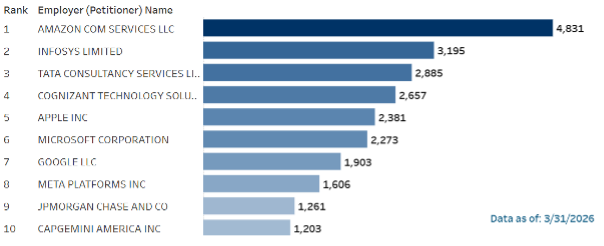
On July 17, 2026, U.S. Citizenship and Immigration Services (USCIS) announced that it has received enough petitions to reach the congressionally mandated 65,000 H-1B visa regular cap and the 20,000 H-1B visa U.S. advanced degree exemption for fiscal year 2027.
USCIS also released data showing the numbers of H-1B workers approved by companies as of March 31, 2026. Below are the top 10 companies hiring H-1B workers:
DHS Rescinds Public Charge Regulation
On July 16, 2026, the Department of Homeland Security (DHS) announced that it has issued a final rule rescinding a 2022 regulation regarding public charge determinations. DHS said the rule “ensures that officers can make highly individualized, fact-specific, case-by-case public charge inadmissibility decisions based on the totality” of each person’s individual circumstances. “This approach will prevent the application of overly restrictive criteria that straitjackets DHS officers’ ability to make public charge inadmissibility determinations.”
DHS said that the rule applies to applications for admission made on or after September 18, 2026, or applications for adjustment of status postmarked or electronically submitted on or after that date. Receipt of means-tested public benefits before September 18, 2026, will be considered consistent with the 2022 final rule, DHS said.
The agency plans to publish a revised Form I-485, Application to Register Permanent Residence or Adjust Status. Older versions of Form I-485 postmarked or submitted electronically on or after the effective date will not be accepted, DHS noted.
No Immediate Changes to TN Visa; USMCA Review Process Begins
On July 1, 2026, the Trump administration announced that it will not renew the United States-Mexico-Canada Agreement (USMCA), triggering the agreement’s built-in six-year review process and beginning a potential 10-year path toward expiration.
Although this development has generated significant attention, there is no immediate impact to Trade NAFTA (TN) nonimmigrant status or the ability of Canadian and Mexican professionals to obtain TN classification. U.S. Customs and Border Protection and U.S. Citizenship and Immigration Services continue to adjudicate TN applications under existing eligibility standards. Employers should therefore continue regular workforce planning practices for current and prospective TN employees.
Under the treaty’s “sunset” provisions, the United States, Canada, and Mexico will engage in annual review discussions. If the parties do not agree to extend or replace it, USMCA would expire on July 1, 2036. This review process is separate from the treaty’s withdrawal provision, which would permit a member country to withdraw upon six months’ notice. No such withdrawal has been announced.
[1] The plaintiff states are Arizona, California, Colorado, Connecticut, Delaware, Hawaii, Illinois, Maryland, Massachusetts, Michigan, Minnesota, Nevada, New Jersey, New York, North Carolina, Oregon, Rhode Island, Vermont, Washington, and Wisconsin.
This is posting is for informational purposes and is not intended as legal advice. If you require further assistance or advice relating to the above, please contact our Partner, Catherine Betancourt at catherine@flynnhodkinson.com.

Catherine Betancourt is a Partner at Flynn Hodkinson, a specialist US immigration law firm in London, where she advises individual and corporate clients on moving to and working in the United States.
Her primary focus is consular processing of immigrant and nonimmigrant visas at US Embassies and Consulates worldwide, with particular expertise in the employment-based and treaty-based routes, including the E-1 Treaty Trader and E-2 Treaty Investor visas, most relevant to UK and Irish businesses relocating people to the US.
1. Is the proposed $100,000 H-1B petition fee currently in effect?
No. The First Circuit declined to continue the temporary stay, so the policy requiring a $100,000 payment with each H-1B petition remains vacated while the underlying appeal continues. A final decision from the First Circuit is not expected until 2027.
2. Could the $100,000 H-1B fee still return?
Yes. The litigation is ongoing, and the policy could be reinstated depending on the outcome of the appeal or later Supreme Court proceedings. Employers planning future H-1B filings should continue to monitor the case.
3. What is the new expedited B visa appointment pilot program?
The Department of State is testing an optional program that allows eligible B visa applicants to pay an additional $750 fee for an interview appointment within 10 business days, subject to availability. The program began at the U.S. Embassy and consulates in Mexico and is scheduled to run through December 31, 2026.
4. Does the $750 expedited appointment fee replace the regular B visa application fee?
No. Applicants must first pay the standard $185 machine-readable visa fee and schedule an appointment through the normal process. The additional $750 payment is required only when an eligible applicant selects an available expedited appointment.
5. What is changing for F, J, and I visa holders?
Beginning September 15, 2026, F, J, and I nonimmigrants will generally be admitted for a fixed period rather than for “duration of status.” Their authorized stay will be controlled by the expiration date on the Form I-94, and they may need to file an extension-of-stay application with USCIS to remain in the United States beyond that date.
6. What should students and exchange visitors check after travelling internationally?
They should review their new Form I-94 immediately after returning to the United States. The I-94 expiration date controls how long they may remain, even when the visa stamp in their passport is valid for a longer period.
7. How will the new F, J, and I rule affect employers and universities?
Organizations will need stronger systems for tracking I-94 expiration dates, passport validity, work authorization, extension filings, and Form I-9 reverification. HR, recruiting, immigration, and compliance teams should also understand who is responsible for maintaining each worker’s status.
8. Has USCIS reached the FY 2027 H-1B cap?
Yes. USCIS announced that it received enough petitions to meet both the 65,000 regular H-1B cap and the 20,000 U.S. advanced-degree exemption for fiscal year 2027.
9. What changed in the public charge rules?
DHS rescinded the 2022 public charge regulation and will return to a more individualized assessment based on the totality of each applicant’s circumstances. The new rule applies to certain admission and adjustment-of-status applications filed on or after September 18, 2026.
10. Will applicants need to use a new Form I-485?
Yes. DHS plans to publish a revised Form I-485. Older editions submitted on or after the new rule’s effective date will not be accepted, so applicants should confirm that they are using the correct version before filing.
11. Has the USMCA review changed TN visa eligibility?
No. There is currently no immediate change to TN classification or the existing eligibility standards for Canadian and Mexican professionals. USCIS and U.S. Customs and Border Protection continue to adjudicate TN applications under the current rules.
12. Could the TN visa eventually be affected by the USMCA review?
Potentially, but not in the immediate future. The review process could ultimately lead to the agreement’s expiration on July 1, 2036, if the United States, Canada, and Mexico do not agree to extend or replace it. This is separate from the treaty’s withdrawal procedure, and no withdrawal has been announced.
Can a UK or Irish Company Use E-2 to Buy a U.S. Business?
A UK or Irish company can make the investment, but the E-2 goes to a person, not the company. What ownership structure decides about who can actually go.

The Questions HR Should Ask Before Hiring a U.S. Visa Lawyer
You are choosing a US visa lawyer for your company and you are not sure what to ask. Twelve questions that show you who actually knows the work.

How to Choose a U.S. Visa Lawyer When the Stakes are Commercial, Not Just Legal
Moving a key employee to the US? How UK and Irish business leaders should assess US visa counsel: what to verify, what to ask, what good advice sounds like.
September 2026 US Immigration Updates: H-1B Changes, Expanded Visa Screening and New Filing Rules
Review September 2026 U.S. immigration updates
How Irish HR Managers Can Prepare for a U.S. Employee Transfer
A practical guide for Irish HR teams moving an employee to the US: which route fits, what to prepare, and how to brief leadership with confidence.
Cross-Border U.S. Acquisitions: The Late Immigration Risk
For UK and Irish acquirers: why the US visa route is set during deal structuring, not after closing, and how to stop immigration derailing the deal.
Managing a U.S. Employee Transfer When You Have Never Done It Before: What HR Needs to Know Before Anything Else
Never managed a US employee transfer? A plain-English guide to what UK and Irish HR teams should get clear before promising anyone a start date.
Five Questions That Determine Whether Your U.S. Expansion Has a Visa Problem
Planning a US expansion? Five questions reveal whether your plan has a hidden visa problem before it delays your launch. From a US visa lawyer.

August 2026 US Immigration Updates: What Employers, Visa Holders and Applicants Need to Know
Review July 2026 U.S. immigration updates on the H-1B fee case and cap, F, J and I status rules, B visa appointments, public charge and TN visas.
What HR Teams in Ireland Need Before Speaking to a U.S. Immigration Lawyer
A practical checklist for Irish HR and mobility teams: the facts, documents and questions to prepare before your first US immigration lawyer call.

Why “We’re Investing Real Money” is Not the Same as “We Have a Viable U.S. Visa Strategy”
Committing capital to a U.S. deal is not the same as having a workable visa plan. How UK and Irish investors test the route before it stalls the deal.
U.S. Work Visas for UK and Irish Employers: a Diagnostic Starting Point, Not Another Directory
There is no single U.S. work visa for employees of UK or Irish companies. Possible routes include the L-1, H-1B, E-1, E-2 and O-1 visas.
Why UK Employers Still Feel Lost at the Start of a U.S. Visa Matter
Capable leadership teams often feel lost at the start of a US visa matter. US visa and nationality lawyer Janice Flynn explains why, and where to begin.

You Are Acquiring a U.S. Company from Ireland. Does the Managing Director Need an E-2, an L-1, or Something Else?
Your Irish company is buying a US business. Does the Managing Director need an E-2, an L-1A, or another route? Read this structure-first guide.
Immigration News Digest – July 2026
Review July 2026 U.S. immigration updates on the H-1B fee case and cap, F, J and I status rules, B visa appointments, public charge and TN visas.
U.S. Immigration Plan for Investors. A 5-Step Framework
If you have committed capital and a deal date but no U.S. immigration plan, here is the five-step framework Janice Flynn uses with investors.

When Leadership Wants Immigration Answers and HR Still Feels Unclear
Leadership is asking for US immigration answers and HR is not sure what to say. Janice Flynn, US immigration lawyer in London, sets out the briefing framework: what to commit to, what to defer, and the questions to bring to the lawyer.

Is There a U.S. Work Visa for Your Employee? That Depends on Five Things Most Companies Have Not Checked
Before you promise a US start date, check these five things. A diagnostic guide for UK and Ireland-based companies from US immigration lawyer Janice Flynn.
U.S. Work Visa Options for Dublin-Based Employers
A plain-language guide to the U.S. work visas that matter for Dublin-based employers, and how to choose between them.

The Cost of Waiting Too Long to Check Whether the U.S. Move Actually Works
UK and Irish investors should test the U.S. immigration plan before the deal structure, relocation date, or investment route is finalised.

What HR Should Clarify Before Giving Anyone a Timeline on a U.S. Transfer
Before HR confirms a U.S. transfer date, eight variables need to be clarified: the visa category, the employee's location, whether premium processing is available, the relevant consular post, the H-1B fiscal year cycle if H-1B applies, whether an LCA is required, the company's document-readiness, and any case-specific complications.
Immigration News Digest – May/June 2026
This digest covers several fast-moving U.S. immigration developments, including litigation over the $100,000 H-1B fee, USCIS processing changes for nationals of 39 countries, processing holds affecting physicians, visa-processing changes in Africa, a new adjustment of status policy, Ebola-related travel and visa restrictions, and a possible end to duration of status for F, J, and I visa holders.
UK & Irish Employee Transfers to the U.S.: 5 Visa Checks
Before promising a U.S. start date, UK and Irish employers should confirm visa eligibility, corporate structure, realistic timelines and total transfer costs.
What Irish Employers Need to Know Before Sending an Employee to the U.S.
You are an Irish owner or investor sending someone to the US. Before you commit, here is what a visa actually requires, from a US immigration lawyer.
Why U.S. Investment Plans Start to Feel Risky When Nobody Has Checked the Immigration Piece
Your U.S. investment is moving forward, but the immigration piece has not been tested against your deal structure. A plain-language guide for UK and Irish investors from a US immigration lawyer with 20+ years' experience.

Your Employee Keeps Asking for U.S. Visa Updates. Here Is What HR Needs First
Your employee wants visa updates and you have no clear answer. Before you chase your lawyer, here is what HR needs to have ready.
May Visa Bulletin Includes Advances in Various Immigrant Visa Categories, Possible Retrogression for India EB-5 Unreserved Category
Five developments from the past four weeks matter most for UK and Irish businesses with people moving or planning to move to the U.S.

The Three Things Every CEO Gets Wrong About U.S. Work Visas Before They Call a Lawyer
Most UK CEOs make three costly assumptions about US work visas before they speak to an immigration lawyer.

Your Irish Company is Expanding to the U.S. Here Is Where to Start with Visas
Your Irish company is entering the U.S. market. Before you move anyone, here is what a CEO needs to know about U.S. work visas, timelines, and the first steps.

You’re Acquiring a U.S. Company and Your Managing Director Needs to Relocate. What Are the Visa Options?
Your company is acquiring a U.S. business and the Managing Director needs to relocate. E-2, L-1, EB-5, Gold Card: which visa fits the deal?
The Eight Pieces of Information Your U.S. Immigration Lawyer Needs Before the First Call: A Checklist for HR
Before your first call with a U.S. immigration lawyer, there are 8 things they will need to assess your case properly. Janice Flynn, a U.S. visa and nationality lawyer in the UK and Ireland, sets out exactly what to prepare.

You Need to Move a Key Employee to the U.S.
Your business needs a key person in the US. But is there actually a visa route available for them? Janice Flynn, US immigration lawyer in London, explains the questions that determine whether a US work visa is realistic and what to do first.
















Firm Update: Rikkilee Barrow Promoted to Senior Associate
The people who work with Flynn Hodkinson define who we are and therefore it is with great pleasure that I...
National Interest Exception Waivers Granted by the US Department of State Extended for 12 Months and Multiple Entries
On 06 July, the Department of State announced the automatic extension of National Interest Exception (‘NIE’) waivers approved within the...
US Citizenship Act 2021 Introduced to the House & Senate
On February 18, 2021, Representative Sánchez (D-CA) introduced the U.S. Citizenship Act of 2021 in the House (see US Citizenship...
Can you still travel to the US directly from the UK, Ireland, Schengen area or Brazil after January 26th?
US COVID travel bans likely still in place for those in UK, Ireland, Schengen area, and Brazil. President Biden...
President Biden Revokes Discriminatory Bans on Entry to the United States
Around mid-day on 20 January 2021, Joseph Biden was sworn in as the next President of the United States, and...
US Entry Alert – From 26th January ’21 Proof of Negative COVID Test Result Required within 72 Hours of US Travel
From the US Embassy in London: “Effective January 26, all airline passengers to the United States ages two years and...
Presidential COVID-19 Proclamations – Clearing Up the Confusion
US Visa and Entry Issues – How Do Trump’s Proclamations Effect You? 2020 can best be described as a...
USCIS Change in US Visa Fees Highlights Attitude Toward the Most Vulnerable
The US Department of Homeland Security (DHS) has announced a new fee schedule for the US Citizenship and Immigration Services...
USCIS Cancels Furloughs for 70% of its Staff!
In a massive turnaround, the US Citizenship & Immigration Services canceled the furlough of 13,000 of its staff. The US...
Signs of Life? US Department of State News
National Interest Exceptions for Travelers from Schengen Area, UK and Ireland & Phased Resumption of Routine Visa Services. More stop...
Updates on Executive Orders Banning Certain Immigrants & Nonimmigrants
April 22nd Executive Order Updated on June 22nd, 2020 Initially, Trump issued an Executive Order on April 22, 2020, entitled...
Flynn Hodkinson Observes Juneteenth
Observance of Junteenth – Why Now? Our firm is made up of American lawyers and so our hearts are with...
US Visa Alert! Possible Expansion of Presidential Proclamation.
If any US employees currently hold H-1B, L-1, H-2B, or J-1 US visas it is advisable that they should return...
Options for US Citizen Expats to Speed Up Spouse-Based Immigrant Visa Processing
The US Citizenship & Immigration Services or “USCIS” is the US agency under the US Department of Homeland Security responsible...
USCIS Extends Flexibility for Responding to Agency Requests
On May 1, 2020, in response to the COVID-19 pandemic, the US Citizenship & Immigration Services (USCIS) announced that the...
Trump’s Executive Order – It only achieves more chaos
On April 22, 2020, President Trump issued an executive order entitled, “Proclamation Suspending Entry of Immigrants Who Present Risk to...
Trump’s Announcement
It’s not the end of US immigration. Instead, immigration will be paused. President Trump announced last night that the...
Trump’s Tweet: What does it mean for US immigration?
“Is this the end of US immigration?” Last night, despite the many other things President Trump should focus on while...
Covid-19 Pandemic US Visa & Entry Issues.
The disruptions in travel caused by COVID-19 have left many in a state of uncertainty regarding their US visa status...
Update: What our firm can do in light of closures & delays of US consular posts & USCIS offices due to COVID-19
What Janice Flynn & Associates can do for you during the COVID-19 pandemic At this time our office can continue...
USCIS Field Office Closure on 31 March 2020
Despite the American Embassy in London temporarily closing for visa processing, the USCIS Field Office, which is housed in the...
FAQs Regarding Proclamation—Suspension of Entry as Immigrants and Nonimmigrants of Certain Additional Persons Who Pose a Risk of Transmitting 2019 Novel Coronavirus
Date 15th March 2020 When did or does the proclamation come into effect? There have been several proclamations relating to...
Firm Statement Regarding Office Operations in Light of Covid-19
As COVID-19 continues to impact all of our lives, our firm would like to update our clients on the steps...
Countries Affected by Trump’s ‘Travel Ban 3.0’ Rise to Thirteen
On 31 January Donald Trump issued a “Proclamation on Improving Enhanced Vetting Capabilities and Processes for Detecting Attempted Entry”. This...
USCIS Adjusts the Premium Processing Fee
Starting on December 2, 2019, USCIS has raised the Premium Processing fee to $1,440 For most petition-based visas, a Premium...
New DHS Rule Redefining Public Charge Inadmissibility Grounds
New US Department of Homeland Security Public Charge Rule Published August 14, 2019 If this existed 100 years ago, my...
US Visa Basics for HR Managers
US Visa Law for Companies At US Visa Solutions we work with many Human Resource departments within small, medium and...
The Royal Birth & US Citizenship
Congratulations to Prince Harry and Meaghan on the birth of their son! Meghan, assuming she hasn’t renounced her US citizenship,...
What to Do When Your Device is Searched at the US Border
In our practice we’ve seen more clients stopped at the US border and had their electronic device, usually a mobile...
US Family Visas: Who Can Sponsor You and How Long Will it Take?
So you have a family member in the United States and you want to move there too? The good news...
US Dept of State Proposes Collection of Social Media Info on Visa Applications
On March 30, 2018, the US Department of State published requests for comments on the Federal Register to collect more...
USCIS Expands Credit Card Payment Option for Fees
The US Citizenship & Immigration Services (USCIS) which processes visa petition and applications under the US Department of Homeland Security,...
Immigration Innovation Act 2018
I-Squared bill, introduced last week by Senators Orrin Hatch and Jeff Flake. The bill seeks to modernize & reform the...
Visiting the US When You Have a Prior Criminal Past – Can all be forgiven?
Lots of people call our office who have prior arrests, cautions or convictions who wish to visit the US. Usually,...
New I-9 Form Requirements
For US Employers – I-9 Form Update The I-9 Form is used to verify the identity and employment authorization of...
Love and Marriage: Spouse-based Immigrant Visas at the US Embassy in London
Update: Please note that this post was initially posted in 2016. In 2019 the USCIS London Field Office announced that...
E-2 Treaty Investor Visas: What exactly is a substantial investment?
The E-2 Treaty Investor is a great visa to use for a broad range of clients. From large publicly traded...
House passed Visa Waiver Program Improvement Act
Yesterday, the House of Representatives passed a bill to restrict the Visa Waiver Program and could bar those with dual...
Report from Dilley
This is the first instalment of a blog that a fellow US immigration lawyer, B. John Ovink, wrote about his...
Renunciation of U.S. Citizenship – Delays in Scheduling Appointments at the US Embassy in London
If you want to renounce your U.S. citizenship by the end of the year (December 31, 2015), we recommend that...
Obama’s Executive Action for US Immigration Reform
Yesterday, 20th November 2014 President Obama announced a series of executive actions to implement major changes in US immigration law and...
USCIS Field Office Alert Regarding Credit Card Payments
Our office received the following alert regarding the payment of US Citizenship & Immigration Services filing fees which could possibly...
Why was Nigella Lawson not allowed to board her flight to the US?
Recently the headlines reported that Nigella Lawson was not allowed to board a flight to the US in Heathrow this...
US Government Shut Down
The US government shut down that took affect last night will not affect the processing of visa applications at the...
1st Anniversary of the Law Office of Janice A. Flynn & US Immigration Reform
Today is the first anniversary of the opening of the Law Office of Janice A. Flynn. It’s been a really...
New US Immigrant Visa Fee to Take Affect 1st February 2013
Individuals issued US immigrant visas on or after February 1, 2013 must pay an additional $165 immigrant fee to theUS...
Special Guest Blog: Where to Incorporate in the United States?
Jonathan Strassberg is a UK-based US commercial lawyer who advises small and medium sized businesses on businesses issues related to...
E-2 Treaty Investor Top Tip: Buying an American Business to Minimize Your Risk
How Do I Minimize My Risk When Buying a US Business When Applying for an E-2 Treaty Investor Visa? The E-2...
Top 10 Things to Know About ESTA
The Electronic System for Travel Authorization or, “ESTA” is a fairly new system implemented in 2009 for those who wish...
Living the Dream: Investing in & Working in a US Business
Maybe you’ve been working hard all your life and you want a change. Or you may have visited the US...
Planning a US Visa Application for HR Managers
In this economy more than ever companies have to keep business moving as quickly as possible. For multinational companies this...
10 Things You Need to Know About US Visa Law
1. There isn’t a one-size fits all US visa. Get good advice on which is the best US visa for...
Consular Processing E-2 Treaty Investor Visa Applications
E-2 visa category can be used for a whole spectrum of sizes and types of businesses from small mom and...
A History of the H-1B Visa Filing Season & Lottery
Its April which, in addition to April Fools Day and April Showers there is what fellow immigration lawyers call the...